Internal & Bluetooth GPS
In TZ iBoat, the term “Internal GPS” refers to any position source that is provided directly by the operating system of the device. This includes the built-in GPS hardware found in phones and cellular-enabled tablets, as well as compatible external Bluetooth GPS receivers that are integrated at the system level. When a Bluetooth GPS is handled by the operating system as the device’s location source, TZ iBoat treats it as an Internal GPS rather than as an external instrument connection.
Note: The Internal GPS is always configured by default and cannot be removed. It can, however, be disabled if needed.
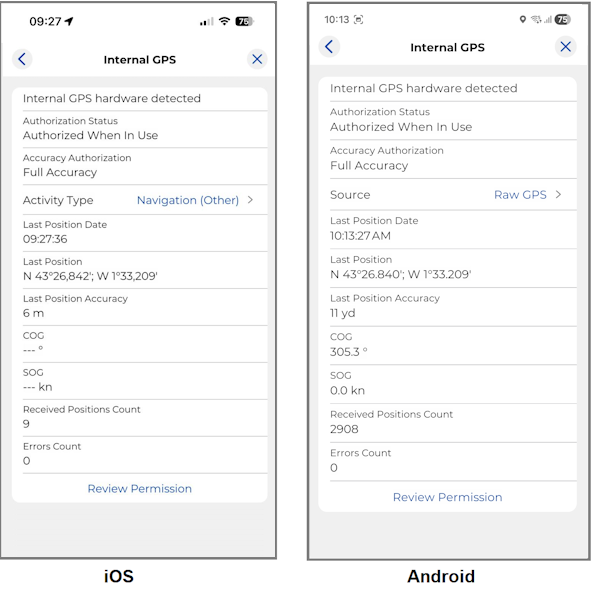
Tap “Internal GPS” in the list to open its detailed status page. This page indicates whether an Internal GPS is available on the device, shows the authorization status, and displays additional information such as the last known position and its accuracy:
IMPORTANT: If no Internal GPS hardware is detected, which is typically the case on Wi-Fi-only iPads, you will need to use a Bluetooth GPS receiver or connect TZ iBoat to an external Wi-Fi NMEA gateway.
On iOS devices, you can configure the Activity Type, which defaults to “Navigation (Other)”. This mode is optimized for navigation applications that are not related to automotive use and provides the most appropriate behavior for marine navigation. On Android devices, you can configure the GPS Source, which is set by default to “Raw GPS”. Android also offers a “Fused Location” option that combines GPS with Wi-Fi and cellular data to speed up position acquisition. However, in a marine environment this method may introduce inaccuracies, for example when a nearby Wi-Fi router appears to move with the vessel. For this reason, it is recommended to keep the default “Raw GPS” setting on Android, except for troubleshooting purposes or when other applications appear to display a different (better) position.
Note that the use of the Internal GPS requires user authorization. At the bottom of the Internal GPS page, tap “Review Permission” to open the device settings and adjust the location permissions for TZ iBoat.
Both iOS and Android internal GPS reports position accuracy to TZ iBoat. When the reported accuracy exceeds 10 meters, a ring is displayed around the vessel symbol, with a radius corresponding to the accuracy value. If the accuracy exceeds 20 meters, a Poor GPS warning is triggered (this warning can be disabled in Settings → Alarms). When the accuracy exceeds 50 meters, TZ iBoat rejects the position and displays a Position Lost alarm if the accuracy does not improve within 30 seconds.
Bluetooth GPS
Bluetooth GPS on iOS
On iOS, a Bluetooth GPS receiver can behave as an Internal GPS source when it is compatible with Apple’s Location Services (Core Location). When the Internal GPS source is selected, TZ iBoat does not communicate directly with the GPS receiver. Instead, it requests position data from iOS itself. When a compatible Bluetooth GPS is paired and connected, iOS can automatically replace the device’s built-in location source with the position provided by the external receiver. All applications that rely on Core Location, including TZ iBoat, then receive this enhanced position transparently, without requiring any additional configuration or instrument connection inside the app. This is why a Bluetooth GPS connected to an iPhone or iPad is still listed and handled as an Internal GPS source in TZ iBoat rather than as an external instrument.
In practice, using a Bluetooth GPS on iOS only requires pairing the receiver with the device and ensuring it is connected while TZ iBoat is running. As long as TZ iBoat has permission to access Location Services, it will use whichever position source iOS is currently providing, whether that is the built-in GPS or the external Bluetooth receiver. If the Bluetooth GPS disconnects or is powered off, iOS will typically revert automatically to the device’s internal location source.
Pairing an external Bluetooth GPS with a Wi-Fi-only tablet, which does not include built-in GPS hardware, is therefore an effective workaround for obtaining reliable position data.
Bluetooth GPS on Android
On Android devices, Bluetooth GPS receivers do not always become the system-wide location source automatically. In many cases, an additional application is required to connect to the Bluetooth receiver, read its GNSS data, and inject that position into Android’s location system using the platform’s mock location capability.
For TZ iBoat, this means that a Bluetooth GPS on Android can be used as an Internal GPS source only if Android itself is providing that receiver’s position to applications through its location services. This typically requires using a manufacturer-supplied utility or a third-party Bluetooth GPS application configured as the device’s mock location provider. Once Android is outputting the Bluetooth receiver’s position as the system location, TZ iBoat can consume it in the same way it consumes the device’s built-in GPS position.